Your income, your other debts and a DTI limit set the most you can spend on housing each month; this calculator turns that budget into a home price after taxes, insurance and mortgage insurance.
Calculate how much house you can afford
Change any input and the results update immediately. The defaults show a $100,000 income, $500 in monthly debts and $40,000 down on a 30-year conventional loan at an example 6.5% rate. Enter a rate from a Loan Estimate or a quote; LoanFight doesn't publish rates.
Results are educational estimates, not a preapproval or a commitment to lend. A lending partner confirms your income, debts, credit and the program's limits before quoting a loan amount.
How the affordability calculator works
Lenders look at two debt-to-income ratios. The housing ratio (front-end) is the full housing payment divided by gross monthly income. The total DTI (back-end) adds your other monthly debts. The total DTI is usually the one that limits how much you can borrow, so the calculator starts there:
- Budget: gross monthly income × your DTI target − your other monthly debts = the most you can spend on the full housing payment.
- Payment: principal and interest + property taxes + homeowners insurance + HOA dues + mortgage insurance or the program's annual fee.
- Solve: it finds the highest home price, to the dollar, whose payment fits the budget. Your down payment stays the dollar amount you enter, or a fixed percentage of the price if you switch to %.
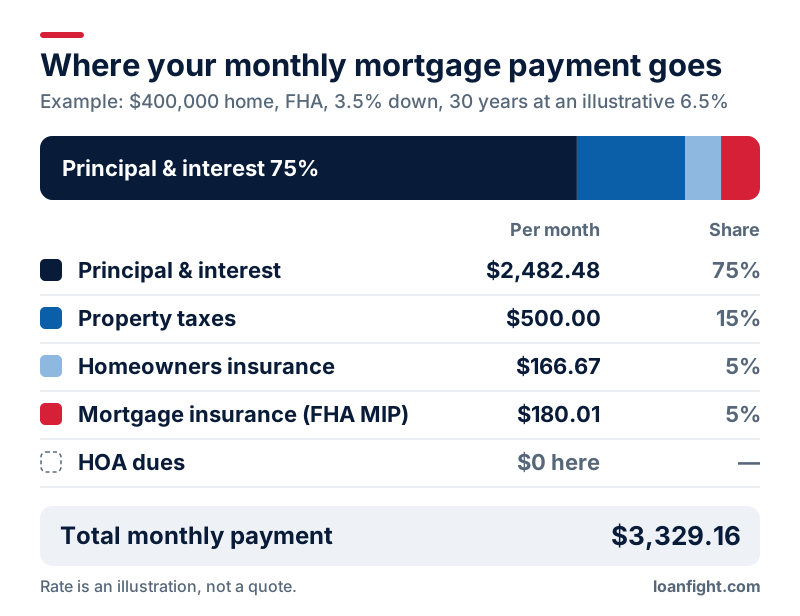
What lenders approve vs. what’s comfortable
The DTI a lender will approve is usually well above the old 28/36 rule. Typical ranges, which vary by lender and by the rest of your file (credit, savings, income history):
- Conventional: commonly approved up to about 45%–50% total DTI with an automated underwriting approval. Manually underwritten files are held to lower ratios.
- FHA: often approved into the 50s, up to about 57% total DTI with an automated underwriting approval; varies by lender. Manually underwritten FHA files use lower limits.
- VA: uses residual income (what’s left each month after the payment, debts and living costs) alongside DTI. Ratios above 41% get a closer look at residual income; lenders may go higher or lower.
- USDA: the standard ratios are 29% for housing and 41% total. USDA’s automated system may approve higher ratios in some cases.
- 28/36: a conservative budgeting guideline (28% of gross income for housing, 36% for all debts), not a lending limit. It describes what’s comfortable, not what lenders approve.
The calculator’s DTI target lets you pick: Comfortable 36%, Typical approval 45% (the default), Program max for the loan type you chose (conventional 50%, FHA 56.9%, VA 50%, USDA 41%) or a Custom target from 20% to 60%. A higher ratio buys more house but leaves less of each paycheck for everything else.
Assumptions by loan type
- Conventional: no upfront fee. Your PMI estimate (0.5% a year by default) is charged on the loan when the loan-to-value ratio (LTV) is above 80%, meaning less than 20% down. Real PMI depends on credit score, LTV and the insurer. The calculator warns below 3% down.
- FHA: a 1.75% upfront MIP financed into the loan, plus annual MIP. On terms over 15 years that is 0.55% above 95% LTV or 0.50% at 95% or below, for base loans up to $726,200 (0.75% and 0.70% above that); 15-year loans use HUD's lower table. Annual MIP is figured on the total loan, the same way the FHA calculator does. Warns below 3.5% down.
- VA: the funding fee is financed: 2.15% with less than 5% down on first use (3.30% on later use), 1.50% with 5% down and 1.25% with 10% or more; exempt veterans pay none. No monthly mortgage insurance. See the VA calculator.
- USDA: a 1% upfront guarantee fee financed and a 0.35% annual fee, with 0% down allowed. The home must be in an eligible area and household income under the local limit, which the calculator does not check. See the USDA calculator.
- 2–4 units: you live in one unit. For conventional and FHA, 75% of the rent you enter for the other units is added to qualifying income; VA shows a note instead, and USDA is one unit only. FHA 3–4 unit homes also get HUD’s self-sufficiency test. See high-cost areas and 2–4 unit homes.
- Property taxes: price × the tax rate you enter. The optional New Jersey picker uses the town's 2025 effective (equalized) rate from the NJ Department of Community Affairs; towns without a published rate fall back to your rate.
- Not included: closing costs and reserves, credit-score approval, county loan limits unless you enter yours (otherwise shown as notes), VA residual income, how a lender counts student loans or variable income, and future changes in taxes or insurance.
Worked example: $100,000 income, $40,000 down
These are the calculator's defaults: $100,000 gross income, $500 in monthly debts, $40,000 down, a conventional 30-year loan at an example 6.5% rate, a 1.0% property tax rate, $1,800 a year of insurance, no HOA and a 0.5% PMI estimate.
| Gross monthly income ($100,000 ÷ 12) | $8,333.33 |
| × 45% DTI target = most for all debts | $3,750.00 |
| − Other monthly debts | −$500.00 |
| = Most for the full housing payment | $3,250.00 |
| Maximum home price | $445,071 |
| − Down payment ($40,000 is 9.0% of the price) | −$40,000 |
| = Loan amount (LTV 91.0%, so PMI applies) | $405,071 |
| Principal and interest ($405,071 at 6.5%, 30 years) | $2,560.32 |
| Property taxes ($445,071 × 1.0% ÷ 12) | $370.89 |
| Homeowners insurance ($1,800 ÷ 12) | $150.00 |
| PMI estimate ($405,071 × 0.5% ÷ 12) | $168.78 |
| Total housing payment | $3,249.99 |
That is 39.0% of $8,333.33 for housing alone; with the $500 of other debts the total DTI is the 45% target. Holding housing to the conservative 28% budgeting guideline instead (before other debts) points to about $323,990.
The same buyer at 36%, 45% and the program max
| DTI target | Housing budget | Maximum price | Loan |
|---|---|---|---|
| Comfortable 36% | $2,500.00 | $346,005 | $306,005 |
| Typical approval 45% | $3,250.00 | $445,071 | $405,071 |
| Conventional program max 50% | $3,666.67 | $500,108 | $460,108 |
| FHA program max 56.9% (same $40,000 down) | $4,241.67 | $567,838 | $537,075 |
Going from 36% to 45% adds $750 a month to the housing budget and $99,066 to the price; going on to the 50% conventional max adds another $416.67 a month and $55,037. The FHA loan includes the 1.75% upfront MIP ($9,237) and is figured with 0.50% annual MIP; 56.9% assumes an automated underwriting approval and varies by lender. The higher targets are what lenders commonly approve, not what’s comfortable: at 50%, half of your gross pay goes to debt payments before taxes, savings and living costs.
These prices come from your income and debts — not a loan limit. Loan limits depend on your county and the number of units; see high-cost areas and 2–4 unit homes. The FHA row’s $527,838 base loan is under even the lowest 2026 one-unit FHA limit of $541,287.
High-cost areas and 2–4 unit homes
The prices above come from income and debts, not from a loan limit. Loan limits are a separate ceiling set by county and by the number of units: in 2026 the one-unit FHA limit runs from $541,287 in most counties to $1,249,125 in the highest-cost areas, and the one-unit conforming limit from $832,750 to $1,249,125. Two- to four-unit homes, where you live in one unit, have higher limits:
| Units | FHA limit, most counties | FHA limit, highest-cost counties | Conforming baseline | Conforming high-cost ceiling |
|---|---|---|---|---|
| 1 unit | $541,287 | $1,249,125 | $832,750 | $1,249,125 |
| 2 units | $693,050 | $1,599,375 | $1,066,250 | $1,599,375 |
| 3 units | $837,700 | $1,933,200 | $1,288,800 | $1,933,200 |
| 4 units | $1,041,125 | $2,402,625 | $1,601,750 | $2,402,625 |
Look up your county with HUD’s FHA mortgage limits lookup and FHFA’s conforming loan limit map. A conventional loan above your county’s conforming limit is a jumbo loan. Enter your county’s limit in the calculator to cap the base loan; the result says whether the limit or your income and debts set the price. With full entitlement there is no VA loan limit, and USDA finances single-unit homes only.
Rental income from the other units
When you buy a 2–4 unit home and live in one unit, lenders commonly count 75% of the expected rent from the other units as income; the 25% cut allows for vacancy and upkeep. The calculator adds 75% of the rent you enter to qualifying income for conventional and FHA loans. Lenders confirm the rent with the appraisal or leases and may ask for landlord experience or extra reserves; requirements vary by program and lender. VA lenders may count the rent when you have property-management experience or reserves, so for VA the calculator shows a note and leaves your income unchanged.
FHA self-sufficiency test for 3–4 units
FHA adds a test for three- and four-unit homes: 75% of the appraiser’s market rent for all the units, including the one you will live in, must cover the full monthly payment (principal, interest, taxes, insurance, MIP and any HOA dues). Take the default buyer with FHA on a 3-unit home, $3,600 a month of rent from the other two units and your unit estimated at their $1,800 average. Income alone supports $596,886 at 45% with a $4,465.00 payment, but 75% of the $5,400 total rent is $4,050.00, so the property may not qualify for FHA at that price; the test passes up to about $542,910. The calculator runs this test when you pick FHA and 3 or 4 units.
Worked example: an FHA duplex
The default buyer ($100,000 income, $500 in monthly debts, $40,000 down, an example 6.5% rate, a 1.0% tax rate, $1,800 a year of insurance and a 45% DTI target), now with FHA on a two-unit home where the other unit is expected to rent for $2,000 a month:
| Gross monthly income ($100,000 ÷ 12) | $8,333.33 |
| + 75% of $2,000 rent from the other unit | $1,500.00 |
| = Qualifying monthly income | $9,833.33 |
| × 45% DTI target − $500 other debts = housing budget | $3,925.00 |
| Maximum home price | $526,652 |
| − Down payment ($40,000 is 7.6% of the price) | −$40,000 |
| = Base loan (LTV 92.4%) | $486,652 |
| + FHA upfront MIP (1.75%, financed) | $8,516 |
| = Total loan | $495,168 |
| Principal and interest ($495,168 at 6.5%, 30 years) | $3,129.80 |
| FHA annual MIP ($495,168 × 0.50% ÷ 12) | $206.32 |
| Property taxes ($526,652 × 1.0% ÷ 12) | $438.88 |
| Homeowners insurance ($1,800 ÷ 12) | $150.00 |
| Total housing payment | $3,925.00 |
The same buyer with FHA on a one-unit home tops out at $438,859, so the $1,500 of counted rent raises the maximum price by $87,793. The $486,652 base loan is far below the $693,050 two-unit FHA floor, so the county limit is not a factor here. Insurance and taxes on a duplex often run higher than on a single-family home, so enter your own figures. At FHA’s 56.9% program max the same duplex reaches about $678,847.
How to afford more house
Starting from the defaults above, here is what each change does to the maximum price at a 45% DTI target:
| Change from the defaults | Maximum price at 45% | Difference |
|---|---|---|
| Defaults (shown above) | $445,071 | — |
| Pay debts down from $500 to $200 a month | $484,698 | +$39,627 |
| Put $60,000 down instead of $40,000 | $462,870 | +$17,799 |
| 6.0% example rate instead of 6.5% | $463,250 | +$18,179 |
| FHA instead of conventional, same $40,000 down | $438,859 | −$6,212 |
- Pay down monthly debts. Every dollar of monthly debt you remove becomes a dollar of housing budget, which is why paying off a car or card balance often moves the number more than saving the same cash for the down payment. Ask before you pay anything off, because some programs treat debts with only a few payments left differently.
- Put more down. A larger down payment lowers the loan and, past 20% on a conventional loan, removes PMI. See down payment and cash to close.
- Shop the rate. Compare Loan Estimates from more than one lender for the same loan; small rate differences change the price you can afford by thousands. The Loan Estimate comparison walks through it.
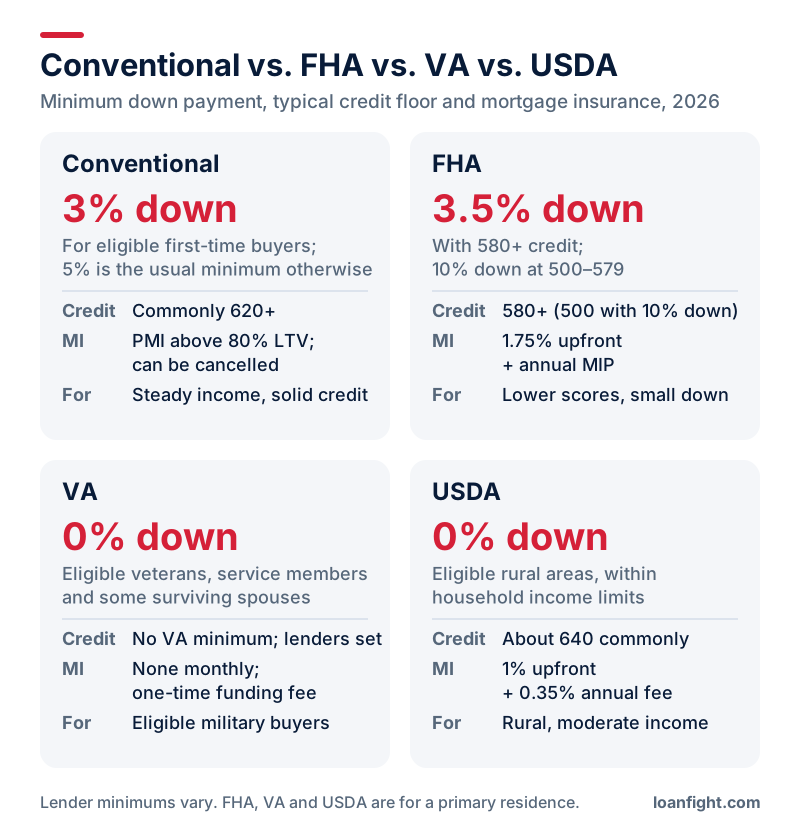
- Look at FHA, VA and USDA. FHA loans allow 3.5% down with a 580+ score, VA and USDA allow 0% down for eligible buyers, and FHA often approves higher DTI ratios through automated underwriting (into the 50s), while VA weighs residual income alongside DTI.
- Use down payment assistance. In New Jersey, state and local programs can help with the down payment and closing costs; see New Jersey first-time home buyer programs.
- Self-employed? If tax returns understate what you earn, bank-statement and other non-QM loans qualify income differently, usually with a larger down payment.
Affordability in New Jersey
New Jersey property taxes are among the highest in the country, and every dollar of monthly tax comes out of the same housing budget as the mortgage. Here is the default buyer with the state's 2025 average effective tax rate of 1.725% instead of the 1.0% example:
| Property tax rate | Monthly taxes | Maximum price at 45% |
|---|---|---|
| 1.0% (calculator example) | $370.89 | $445,071 |
| 1.725% (NJ statewide average, 2025) | $592.51 | $412,178 |
The higher tax costs $221.62 more a month at a lower price and cuts the maximum price by $32,893. Town rates range widely, so pick your town in the calculator above, look up rates and bills on the NJ property taxes by town page, or run a specific home through the New Jersey mortgage calculator.
Turn this estimate into a real preapproval
LoanFight is not a lender. Tell us about your income, debts and the home you want; we review your scenario and connect you with a lending partner who can confirm what you qualify for.
See My Loan Options →How much house can I afford? FAQs
How much house can I afford on a $75,000 salary?
About $321,000 at a 45% DTI target, a common approval level, using the calculator defaults: $500 in monthly debts, $40,000 down, a conventional 30-year loan at an example 6.5% rate, a 1.0% tax rate, $1,800 a year of insurance and a 0.5% PMI estimate. At a conservative 36% it is about $247,000, at the 50% conventional program max about $363,000, and with FHA at 56.9% (with an automated underwriting approval; varies by lender) about $414,000. Your own rate, taxes and debts change the answer.
How much house can I afford on a $100,000 salary?
About $445,000 at a 45% DTI target with the same assumptions, for a housing payment of $3,250 a month. It is about $346,000 at a conservative 36%, about $500,000 at the 50% conventional program max, and about $568,000 with FHA at 56.9% (with an automated underwriting approval; varies by lender). With less debt or more money down the number goes up; with higher taxes it goes down.
What is the 28/36 rule?
It is a conservative budgeting guideline, not a lending limit: keep the full housing payment at or below 28% of gross monthly income and all debt payments, including housing, at or below 36%. Lenders commonly approve conventional loans up to about 45%–50% total DTI with automated underwriting and FHA loans often into the 50s, so 28/36 describes what’s comfortable, not what lenders approve.
Does DTI include rent or utilities?
No. Your current rent is replaced by the new housing payment, and utilities, phone bills, groceries and insurance other than homeowners insurance are not counted. DTI counts the new housing payment plus debts such as car loans, student loans, minimum credit card payments, other mortgages, and child support or alimony.
How much down payment do I need?
Less than many people think. Conventional loans allow 3% down for eligible buyers, FHA allows 3.5% with a 580 or higher credit score, and VA and USDA allow 0% for eligible borrowers. Putting 20% down on a conventional loan avoids PMI. You also need cash for closing costs and any reserves the lender requires.
Does my credit score affect how much house I can afford?
Yes, mostly through the rate and mortgage insurance. A higher score usually means a lower rate and, on conventional loans, lower PMI, which leaves more of your budget for the loan itself. FHA mortgage insurance is not priced on credit, though your score still affects approval and the rate.
Can I afford more with FHA or with a conventional loan?
At the same DTI, it depends on your credit and down payment. With the calculator defaults, $40,000 down and a 45% target, conventional with a 0.5% PMI estimate allows about $445,000 and FHA about $439,000, because FHA adds a 1.75% upfront premium and 0.50% annual MIP. FHA often approves a higher DTI, though: at its 56.9% program max (with an automated underwriting approval; varies by lender) FHA reaches about $568,000, versus about $500,000 at the 50% conventional max.
Can I afford more with a co-borrower?
Usually, because the lender adds both incomes and both sets of debts. Adding a co-borrower who earns $50,000 with $300 in monthly debts to the default example raises income to $150,000 and debts to $800, and the maximum price at 45% to about $653,000. Both borrowers sign the loan and are fully responsible for it.
Can rental income from a 2–4 unit home help me qualify?
Yes, if you live in one of the units. Lenders commonly count 75% of the expected rent from the other units as income, with the 25% cut allowing for vacancy and upkeep, and may ask for leases, landlord experience or extra reserves. With the calculator defaults and FHA at a 45% DTI target, $2,000 a month of rent from the other half of a duplex adds $1,500 of qualifying income and raises the maximum price from about $439,000 to about $527,000. Three- and four-unit FHA purchases must also pass HUD’s self-sufficiency test.
What are the 2026 FHA loan limits for 2–4 units?
They depend on the county. In 2026 the FHA limit runs from $693,050 to $1,599,375 for two units, $837,700 to $1,933,200 for three units and $1,041,125 to $2,402,625 for four units, compared with $541,287 to $1,249,125 for one unit. Check your county’s figure with HUD’s FHA mortgage limits lookup.
Sources
- CFPB Regulation Z §1026.43 — the ability-to-repay rule, which requires lenders to consider debt-to-income or residual income.
- CFPB: Buying a house — tools and guides for home buyers.
- CFPB: Loan Estimate explainer — how to read and compare Loan Estimates.
- Fannie Mae Selling Guide B3-6-02: Debt-to-Income Ratios — how DTI is calculated and conventional maximums.
- HUD: FHA Single Family Housing Policy Handbook 4000.1 — FHA underwriting, including debt-to-income ratios with automated and manual underwriting, rental income from 2–4 unit homes and the 3–4 unit self-sufficiency test.
- HUD: FHA mortgage limits lookup — FHA loan limits by county and number of units.
- FHFA: Conforming loan limit values for 2026 and conforming loan limit map — baseline and high-cost limits by number of units.
- Fannie Mae Selling Guide B3-3.1-08: Rental Income — how rent from a 2–4 unit principal residence is counted, including the 75% factor.
- 38 CFR 36.4340 (eCFR) — VA underwriting standards: the 41% debt-to-income benchmark and residual income.
- HUD: FHA Mortgage Insurance Premium structure and Mortgagee Letter 2023-05 — upfront and annual MIP.
- VA: Funding fee and closing costs — funding fee rates and exemptions.
- USDA Single Family Housing Guaranteed Loan Program and USDA eligibility site — fees, eligible areas, income limits and the guaranteed program’s underwriting standards.
- NJ Department of Community Affairs, Property Tax Information — 2025 equalized tax rates and average bills by town.
Educational estimate only. LoanFight is not a lender, does not make credit decisions and does not set loan terms. The default interest rate, tax rate and PMI rate are examples, not quotes. Your lending partner will provide actual figures on a Loan Estimate.